Meet the trainee: Taryn Thompson on studying air pollution and early onset type 2 diabetes using CanPath data
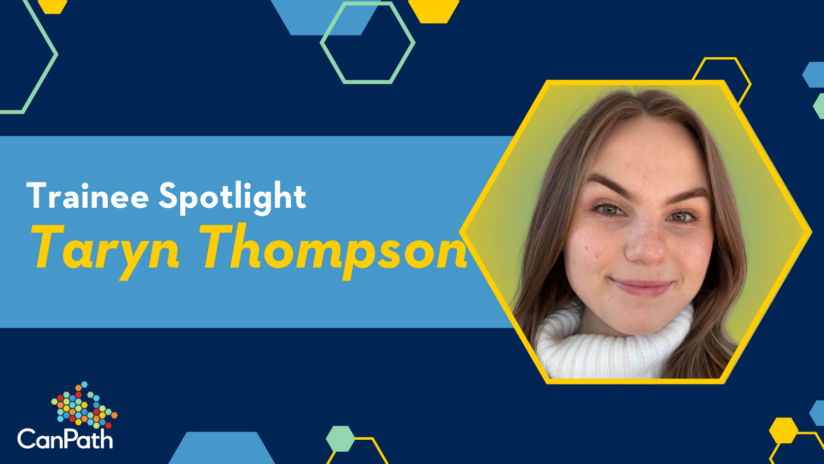
Students are the future of research and providing opportunities for young researchers to explore their interests not only prepares them for their careers but can lead to some incredible scientific breakthroughs. We had the wonderful opportunity to chat with Taryn Thompson, a previous CanPath student who completed her first Masters of Public Health in Epidemiology practicum with us. Taryn spent four months working on a project that examined the association between air pollution and early onset type 2 diabetes using both CanPath and CANUE data.
We asked Taryn to share with us her day-to-day activities, key learnings and the value of CanPath in supporting her work. Check out the full length interview on our YouTube:
Q: Could you tell us a little bit about your role and what your day-to-day looks like?
As a practicum student with CanPath, my day-to-day involved lots of literature reviews at first to find exactly what I wanted to explore. We were allowed to explore our own interests related to environmental exposure, specifically air pollution, so I decided to explore the relationship between air pollution and early onset type 2 diabetes. My days were spent planning the analysis so a lot of thought went into how we wanted to clean the data, what variables we wanted to pull in, how we wanted to structure our variables and, what analysis was best to answer our research question. A lot of it was the planning beforehand and then going from there, the actual analysis came in and straight to writing a paper.
Q: What is one thing you learned about when you were working with population cohort data that you didn’t expect when you first started?
I did not expect the amount of time that went into planning the analysis. We cover that in school, how to plan the analysis and things to consider, but when you start to go in depth and every dataset is so unique even though variables are similar, their structures can be very different. It takes a long time to get to know your data well… I thought it was a more linear process but you end up cycling through your plan often.
Q: What made canpath valuable for the research you were supporting?
Canpath has such a wealth of different variables that we have collected from participants that isn’t often available in administrative datasets such as, physical activity and diet. This gave me the ability to explore my output and exposure while controlling for variables that you aren’t frequently always able to control for, so that was really great. Also, because of the size of the cohort, early onset type 2 diabetes is not very frequent so having a larger population allowed me to look at this more rare outcome and explore the association with air pollution.
We hope to continue to support practical learning opportunities for students like Taryn to explore their own interests and build their future careers through access to population health data. At CanPath, we are grateful to work with incredibly talented students who contribute strongly to our team and to the field of health research.
For more information, please contact:
Eva Schaessens
Communications & Knowledge Translation Officer
Canadian Partnership for Tomorrow’s Health (CanPath)
info@canpath.ca