“How Do We Know Synthetic Data Is Protecting Privacy?”
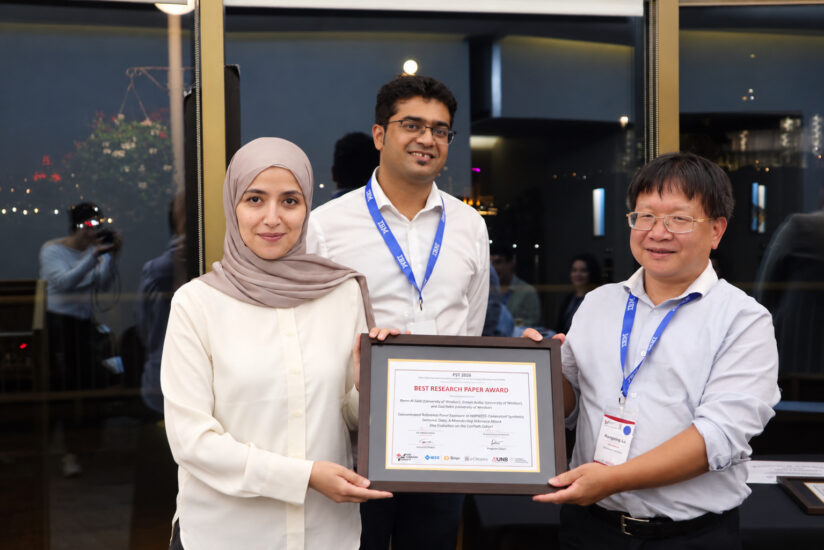
Dr. Reem Al-Saidi (left) receives the Best Research Paper Award from the General Chair of PST 2026.
CanPath is pleased to congratulate Dr. Reem Al-Saidi on receiving a Best Research Paper Award at the 23rd Annual International Conference on Privacy, Security, and Trust (PST 2026).
The study, Concentrated Reference-Panel Exposure in HAPNEST-Generated Synthetic Genomic Data: A Membership Inference Attack Evaluation on the CanPath Cohort, was led by Dr. Al-Saidi under the supervision of Dr. Ziad Kobti at the University of Windsor and conducted in collaboration with CanPath. It asks a simple but pressing question: can synthetic genomic data reveal traces of the real people whose data helped create it? The paper was recognized for its originality and its contribution to understanding privacy risks in synthetic data.
Why synthetic data needs testing
Put simply, synthetic data is artificially generated data designed to look and behave like real-world data. The records are not real, but the patterns and relationships in them closely resemble the original dataset. Researchers can learn from it, students can train on it, and organizations can explore new ideas, all without releasing real participant data.
Yet, according to Dr. AlDr. Al-Saidi, the privacy of synthetic data cannot be taken for granted.
“For years, synthetic data was treated as private by default. The records belong to no real person, the thinking went, so they cannot reveal anything about one. That view no longer holds,” said Dr. Al-Saidi.
“Synthetic data can be private, but that has to be tested, not assumed.”
Putting privacy to the test
A recent PhD graduate of the University of Windsor, Dr. Al-Saidi works on privacy-preserving machine learning and genomic data privacy. Working with CanPath’s synthetic genomic data, she took on a question that grows more important as synthetic data gains popularity in research and education: how can we tell whether synthetic data is truly protecting privacy?
Working inside CanPath’s secure environment before any data was released, she evaluated 1,039 participants from the BC Generations Project to answer a key question: if someone tried to work backwards from the synthetic records, could they tell whether a real person’s data had been used to create them?
“For 1,017 participants, representing nearly 98% of those studied, the evaluation found no detectable trace. For the remaining two percent, their contribution could still be detected, even though the data had passed every standard quality check,” said Dr. Al-Saidi.
Alongside these findings, the evaluation revealed an unexpected pattern in the ordering of synthetic records. Because the assessment was conducted before release, the pattern was identified and addressed before any data was shared. That, Dr. Al-Saidi notes, is exactly the point of testing privacy rather than assuming it.
A collaboration built on shared goals
The project brought together academic privacy research and CanPath’s data expertise. Dr. Kobti’s research group at the University of Windsor contributed the privacy evaluation methods, while the CanPath team provided the synthetic dataset, secure access to the evaluation environment, and deep knowledge of the cohort.
“Reem’s work with CanPath didn’t take the privacy of synthetic data for granted. She tested it rigorously on the CanPath cohort, and her findings changed how we think about sharing genomic data. Her best paper award is well deserved, and I’m proud of what she has accomplished,” said Dr. Ziad Kobti.
For CanPath, the project shows the value of making synthetic data available for research and education. By giving researchers the opportunity to examine real-world questions, synthetic datasets can do more than support learning. They can help advance the field itself.
The synthetic genomic data used in the study was recreated and prepared by CanPath trainee Amy Li. Originally developed to support genomics education and research, the dataset provided the foundation for work that contributed new knowledge to an evolving area of privacy research.
“I was just so proud of Reem and the team,” said Amy Li.
“It’s really important work that we’re doing.”
Dr. Al-Saidi’s research is one example of what can be achieved with CanPath’s synthetic data resources, and of how open, collaborative research can strengthen the privacy protections participants rely on.
Whether you’re an educator, student, or researcher, CanPath’s synthetic datasets offer opportunities to explore real-world questions, develop new skills, and test innovative ideas. Learn more and apply for access: CanPath Synthetic Dataset