Synthetic Doesn’t Mean Private: Testing HAPNEST-Generated Genomic Data on the CanPath Cohort
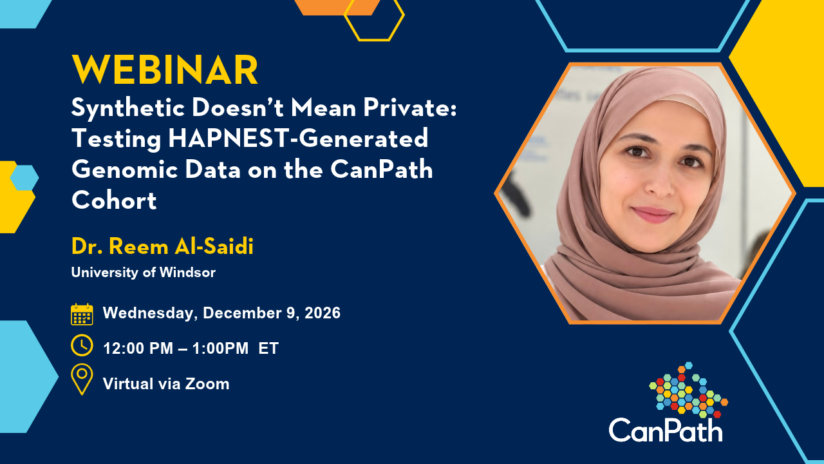
Synthetic data, artificial data created to resemble real data, is often seen as a safe way to share health information for research. But is it truly private? In this webinar, Dr. Reem Al-Saidi shares findings from an award-winning study that tested synthetic genetic data created from CanPath participants. The results show that some participants can still be identified as part of the original data. Attendees will learn why “synthetic” doesn’t automatically mean “private,” and what this means for how health data is shared safely in research.
Presenter Bios:
Dr. Reem Al-Saidi, University of Windsor
Dr. Reem Al-Saidi completed her PhD in computer science at the University of Windsor in 2026, studying privacy vulnerabilities in large language models trained on sensitive data such as genomic sequences. She has published in a top-tier journal on the privacy and security of genomic data sharing and held a visiting research position at the Karlsruhe Institute of Technology in Germany, where she researched synthetic genomic data. Her work aims to make genomic data sharing safer so that health research can advance without compromising participant privacy.
Dr Victoria Kirsh, Canadian Partnership for Tomorrow’s Health (CanPath)
Dr. Victoria Kirsh serves as the Scientific Coordinator for the Canadian Partnership for Tomorrow’s Health (CanPath). She is currently the Interim Director of the Ontario Health Study, one of CanPath’s regional cohorts. Dr. Kirsh completed a Ph.D. in Epidemiology from Yale University, and an M.Sc. in Epidemiology from the University of Toronto. She completed a fellowship at the U.S. National Cancer Institute, Division of Cancer Epidemiology and Genetics. She also serves as an Assistant Professor (status-only) at the Dalla Lana School of Public Health, University of Toronto.