Dietary data in action: How the HEAL study helps researchers study food insecurity and diet
The HEAL (HEALthy Eating and Supportive Environments) study has always been about more than collecting data. It’s about what that data can do.
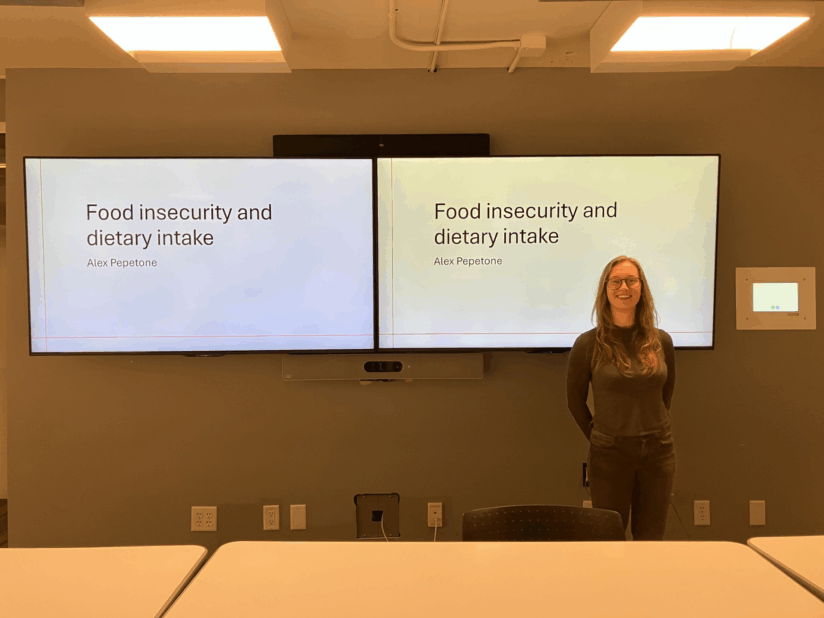
Last week, HEAL study project manager Alex Pepetone showed what that looks like in practice, presenting at the Cancer Prevention Research Cluster (CPRC) Research Showcase at the University of British Columbia (UBC) on how HEAL dietary data could help answer a critical question: do experiences of food insecurity shape the quality of what Canadians eat?
What is the CPRC?
The Cancer Prevention Research Cluster is a transdisciplinary research group based at UBC’s School of Population and Public Health. Given that an estimated 40% of cancers are preventable, their mission is to bring together researchers, practitioners, and partners to close the know-do gap, i.e., the gap between what we know about cancer prevention and what we actually do about it.
What did Alex present?
Alex shared her proposed research on food insecurity and diet quality and how HEAL data makes that research possible.
Food insecurity means not having reliable access to food due to limited financial resources. It’s a serious public health issue in Canada that has the potential to shape what people eat. For example, the high cost of food can shape what people are able to access and eat. Living in food-insecure households is linked to poor health, including an increased risk of cancer. Alex’s research will look at whether food insecurity is linked to lower diet quality, a factor that can shape the risk of developing cancer.
To do that, she’ll look at dietary data collected three different way, from short questionnaires to detailed day-by-day food logs, and use both traditional statistics and machine learning to find patterns in the data. The HEAL study provides exactly the kind of large-scale, real-world dietary information this kind of research needs to work.
Why does this matter?
Diet is an important factor linked to poor health, including cancer risk. But understanding how diet connects to cancer, especially for people facing barriers like food insecurity, requires large, high-quality datasets from across the country. The HEAL study was built to provide this novel resource.
Alex’s presentation was part of a broader showcase focused on collaboration. She identified three areas where working with CPRC researchers could strengthen her work: building the link between food insecurity and diet and cancer prevention, improving her research methods by applying machine learning, and extending the reach of her findings through knowledge translation.
“The whole focus of the event was collaboration … finding where your work overlaps with someone else’s and seeing what’s possible,” said Alex. “I shared three areas where I thought working with others could strengthen my research and the work with the HEAL study, and I walked away with such helpful advice and some really promising connections.”
The bigger picture
The HEAL study was designed to generate research like this. Every participant who logs what they ate and how they moved, and shares details about their neighbourhood is contributing to a dataset that researchers across Canada are using to ask better questions about health.
Alex’s presentation and work is one example, and our team is eagerly awaiting all that’s to come.