Meet the trainee: Feifan Xiang on analyzing breast cancer screening disparities and second cancers with CanPath data
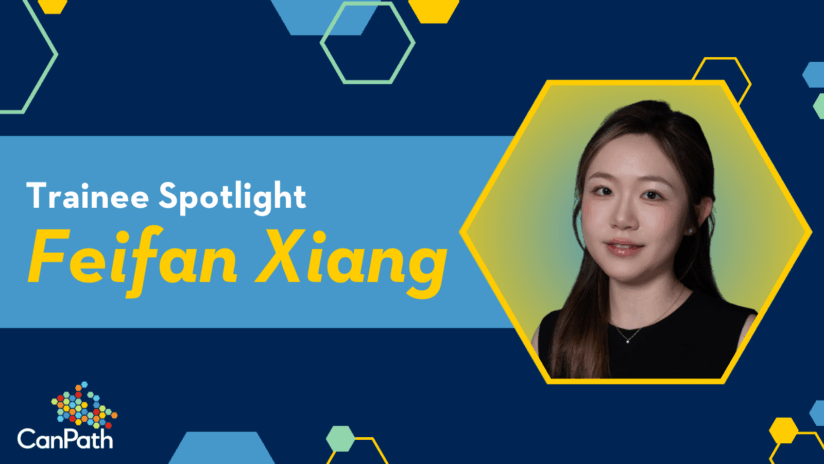
Science is only made possible by the collaboration of researchers, data analysts, and participants who come together to improve our understanding and make information accessible to the public. We had the wonderful opportunity to sit down with Feifan Xiang, a data analyst working with CanPath data to investigate breast cancer screening disparities. Through our Trainee Spotlight Series, we want to highlight the wonderful work of trainees and students who use our data to make great strides in public health.

We asked Feifan to give us a glimpse of her day-to-day life as a data analyst, share more about her career trajectory, and offer advice for students looking to break into the field of research. The full interview can be found on our YouTube channel, and here are some highlights:
Q: Could you tell us a little bit about your role and what your day-to-day looks like?
“I am a part of the data analysis team, and we’re mostly working on breast cancer screening disparities and then also among those breast cancer patients, their second cancer occurrence. My day-to-day is mostly sitting at my laptop and attending regular meetings where we share our updates and also brainstorm new ideas. It sounds repetitive, but we are making small progress each day and tackling problems we encounter along the way.”
Q: What is one thing you have learned about from this project that you didn’t expect to learn?
“Working with large population cohort data comes with an extensive set of variables. One thing that always amazed me is the privilege that we have to expand our analysis across so many different directions. We can look at clinical, behavioural and genomic factors in our analysis, which brings in lots of different directions we can go with the large population data that we have.”
Q: How did working on this project shape how you see population health research?
“With the rich dataset provided for use by CanPath, we have access to a large sample size. It’s really a nationwide cohort, and the time frame it spans is hundreds of thousands of people over decades. For me, it’s great to see specifically for breast cancer how the treatment evolved over time and then what cancer characteristics people collect throughout the years, the changes made to them and most importantly, the improvement in disease outcome and life expectancy over the years due to advances in treatment and the preventive screening programs that are provided to breast cancer patients. “
Q: How will working with population health data influence your future career trajectory?
“I enjoy working with population cohort data. Specifically, working with provincial health administrative data and the dataset I’m working on right now is linked to other provincial datasets. Working with both datasets allowed me to learn more about how these variables are curated and coded over the years, including any coding or variable changes. I have definitely learned a lot, and in my future career, I think I will probably come across provincial health data again. I already have a working knowledge of it, so it will definitely help me use that data in the future. “
Feifan has supported important health equity research and learned a great deal about working with population health data. CanPath is proud to work with dedicated trainees who are shaping the future of health research and public health work. Check out our website for more information on current projects and team members, as we will continue to share the amazing work being conducted by incredibly talented trainees and students.
For more information, please contact:
Megan Fleming
Communications & Knowledge Translation Officer
Canadian Partnership for Tomorrow’s Health (CanPath)
info@canpath.ca